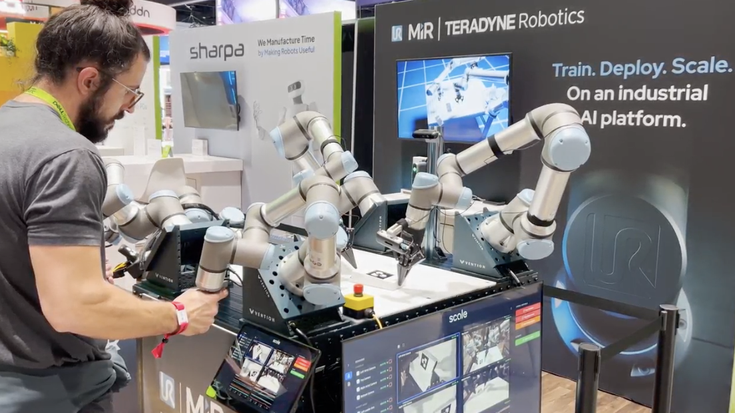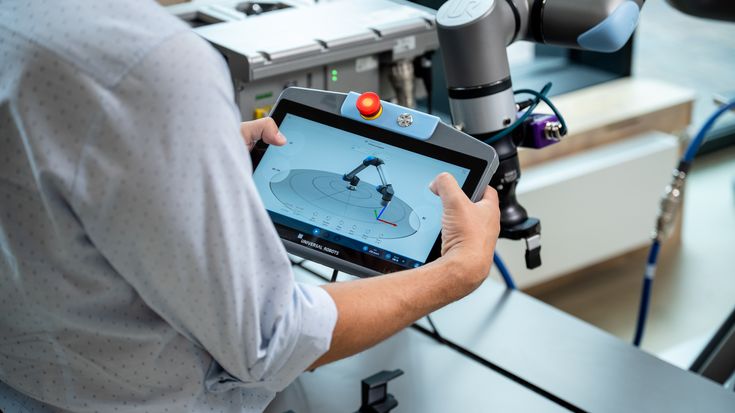
Universal Robots’ September 2026 Gen 7 announcement put data, power, and safety connections at the new g-Series tool flange. It also listed force-torque sensing, impedance control, and real-time data exchange. These are specific provisions for sensing and interaction. They do not make a gripper intelligent on their own, but they affect how a learned policy can observe and influence a physical task. Universal Robots Gen 7 launch.
A flexible robot cell should be able to handle variation without turning each new part into a programming project. But flexibility alone is not a production result. The cell still needs to deliver the right item, in the right state, at a useful pace. Autonomous adaptation should be evaluated against that concrete operating contract.
Transporter Networks, submitted October 27, 2020, studied visual manipulation by predicting spatial rearrangements. The researchers tested tasks such as assembly-like placement and object handling, with both simulated and hardware experiments. These results demonstrate a learning approach, rather than production readiness for every industrial cell. Transporter Networks paper.
Inspect the output
In our view, the acceptance test should include the part after the robot releases it. A successful grasp is only an intermediate event if the object is misoriented, damaged, or placed where the next station cannot use it. A hypothetical kitting cell should verify kit completeness and component identity, not only the number of picks attempted.
QT-Opt's June 27, 2018, paper explored closed-loop visual grasping using reinforcement learning and a large collection of robot attempts. Its ability to update behavior from new observations is relevant to variation during handling. The reported success rate belongs to the research's evaluated conditions. QT-Opt paper.
Test the surrounding process
We would also include replenishment, rejected parts, and recovery from interruption in the cell trial. These moments reveal whether autonomy reduces operator burden or simply moves it outside the demonstration. Flexible workcells become convincing when the complete process produces accepted output consistently. A capable policy is one component of that process, alongside sensing, fixtures, controls, and an understandable exception path.
The cell is the real unit of work
A robot arm is often shown as a complete machine, yet the business outcome occurs at the contact point. A part must be held without damage, inserted with the right alignment, or placed in a location the next machine can use. The gripper, fixture, sensing, and controller all contribute. If one of them changes, the meaning of the same commanded motion can change too.
That is why a connection standard has operational significance. A camera mounted near the tool can provide a different view from one mounted above the cell. A force sensor can reveal contact that is visually ambiguous. Integrating those signals predictably gives an application more useful evidence. It does not guarantee that the evidence is interpreted correctly.
Perception is moving into the control platform
ABB’s EyeMotion release described using third-party cameras or sensors with OmniCore-powered robots and configuring applications through a web interface and RobotStudio. The company presented this as a route to real-time adaptation. This is a vendor capability claim, not independent proof of performance under every lighting condition or part variation. It nevertheless makes the integration layer explicit rather than treating vision as an isolated demonstration. ABB OmniCore EyeMotion launch.
A grasp has several opportunities to fail
The historical grasping and Transporter research below helps explain the appeal of this approach. Choosing a contact or placement from visual information can be more flexible than following a fixed trajectory. But a successful selection still has to survive execution. The object may move, the package may deform, the tool may slip, or a neighboring part may obstruct the chosen path.
These failures have different signatures. Some are visible before contact. Others appear only through force, vacuum pressure, or the state of the object after release. A controller that can combine signals has a richer basis for recovery. A benchmark that scores only the selected grasp point will not capture the entire chain. The deployment question is whether the cell recognizes and handles the failure before it propagates downstream.
The integration promise needs application evidence
There is a strong reason for industrial suppliers to emphasize simpler sensor and tool connections: every custom integration can become a source of engineering work and later maintenance. A cleaner interface can make experimentation faster and replacement more predictable. It can also allow the same perception software to be tried across more than one cell. Those are plausible benefits of the architecture, distinct from a claim that the robot understands arbitrary objects.
The remaining evidence must come from the assembled application. Does changing a gripper require retraining? Does the system detect that a camera has shifted? Does a damaged package produce a safe stop, a retry, or an incorrect placement? These are not peripheral concerns. They determine whether flexible perception translates into dependable output.
The Gen 7 and EyeMotion releases show a concrete direction of travel: robot platforms are exposing more of the physical interaction to software. The autonomy gained will be task-specific and constrained by the evidence available at the tool. The most useful systems will make that evidence easier to interpret and the resulting behavior easier to verify.
The research context
Transporter Networks, introduced in October 2020, represented manipulation through spatial relationships in visual observations and studied tasks including picking and placing. The approach helps explain why perception and control are closely linked at the tool. A predicted destination is meaningful only relative to the robot, object, and workspace. If a camera moves or a gripper changes, that relationship may change even when the visual task sounds identical. Industrial interfaces that simplify connecting sensors are therefore only one part of the solution. The application must preserve the coordinate relationships and feedback that make their outputs useful. This is the difference between attaching a camera and establishing a dependable visual control loop for the work being performed. Original research source.
Sources & evidence
This archive preserves its original editorial date. Sources describe the events and announcements discussed; they do not establish today’s status.