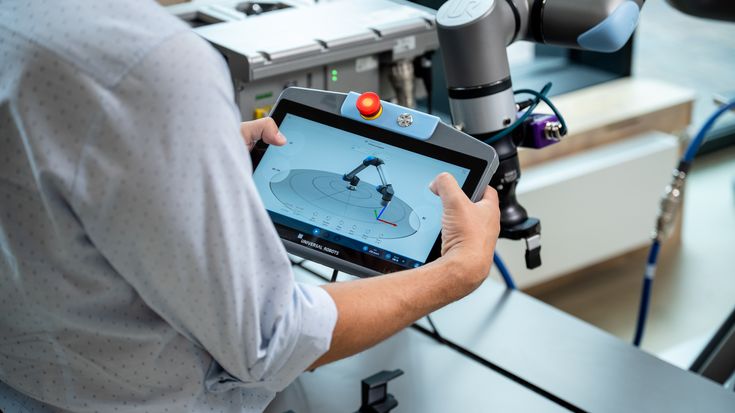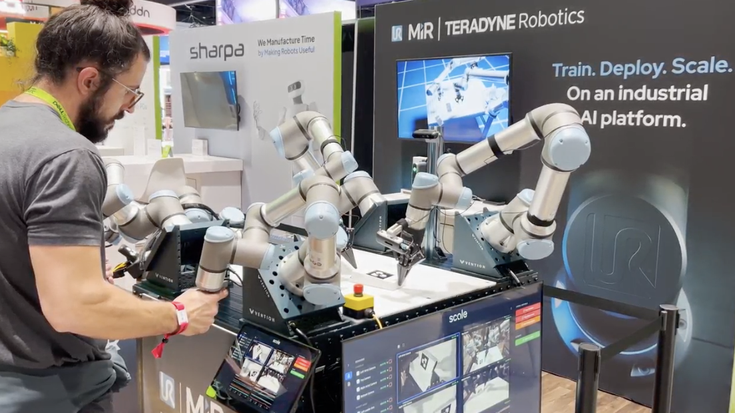
At GTC on March 16, 2026, Universal Robots and Scale AI introduced the UR AI Trainer, recording motion, force, and vision in a leader-follower setup. A parallel simulation used NVIDIA Omniverse and Isaac Sim. These were data-collection demonstrations, not certification of a production cell. Universal Robots and Scale AI launch AI Trainer.
Simulation offers a way to try many conditions without consuming physical parts or occupying a production line. Its value for autonomy depends on the assumptions being varied. A visually rich virtual scene can still omit the one source of variation that makes the real robot fail. The useful question is what uncertainty the simulation actually explores.
The domain-randomization paper submitted March 20, 2017, studied transferring visual models from simulation by varying rendered conditions. It demonstrated object-localization and grasping applications. The work established a research technique for reducing reliance on perfectly realistic images, not a universal solution to all differences between simulation and hardware. Domain Randomization paper.
Vary what affects the decision
Our recommendation is to start from observed or plausible failure modes. If reflection changes object detection, vary materials and lighting. If clutter hides the grasp target, vary occlusion. If the problem is physical contact, changing image textures alone will not address it. Each simulation campaign should state which source of uncertainty it is intended to test.
ARRO, first submitted May 13, 2025, examined visual robustness by masking irrelevant scene regions and adding visual guides. The authors reported improvements in their evaluated manipulation settings. It offers a complementary approach: change the representation of the scene, as well as the examples used for training. ARRO paper.
Close the physical loop
We would reserve a physical test set that simulation tuning does not repeatedly absorb. Use it to determine whether the intended gap is actually narrowing. When a new field failure appears, revise the assumptions and rerun both tests. Simulation strengthens autonomous deployment when it is part of an evidence loop, rather than a visually impressive substitute for the real cell.
The hardware platform followed in September
Six months later, Universal Robots introduced Gen 7 with PolyScope X, open APIs, and ROS 2 communication among its software features. The sequence connects data collection with a platform intended for industrial deployment. It does not establish that every model trained in the March demonstration can be installed without further engineering on every September product. Universal Robots Gen 7 launch.
What a simulator can make easier
Simulation allows an engineer to alter a scene, repeat a trial, or examine a failure without consuming a physical part. That is valuable for development. It can also expose whether a policy depends on a narrow camera angle or a convenient starting position. The domain-randomization research discussed below formalizes part of that idea by varying aspects of the simulated environment during training.
The limitation is not that simulation is unreal. It is that each simulated environment contains choices about what to represent and how accurately. Contact, friction, deformation, and sensing may matter differently for different tasks. A simulated pick from a rigid box is not the same challenge as an insertion that depends on a small force change. The relevant question is which assumptions affect the behavior being learned.
A shared robot can narrow the comparison
Training on the intended hardware can remove one source of uncertainty: translating between different embodiments. It does not remove variation in objects, lighting, calibration, or wear. A leader-follower system also records the operator’s choices, including how they recover from difficulty. Those choices become part of the data available to the learner.
This makes data quality more specific than collecting a large number of trajectories. The record needs to capture the event that matters. If a successful insertion depends on feeling a small obstruction, video alone may not explain the correction. If a task fails because the camera cannot see behind a gripper, adding more demonstrations from the same view may preserve the ambiguity. The March system’s inclusion of several synchronized signals addresses this kind of problem at the collection layer.
The next claim belongs to the deployed task
A convincing transition from simulation to a factory is not one uninterrupted success video. It is an account of what changed between the virtual and physical setup, how the model was adapted, and which failures remained. Without that account, a result may reflect extensive manual tuning that the word transfer conceals. With it, the result can become reusable engineering knowledge.
The two Universal Robots announcements are therefore complementary. AI Trainer provides a way to create relevant experience; Gen 7 supplies interfaces through which more capable software may operate. Between them lies the work of adapting and validating a specific behavior. That work is where the quality of the simulation and the quality of the physical data become measurable.
The commercial opportunity is substantial precisely because this bridge is difficult. A repeatable route from task demonstration to supported operation would reduce the cost of introducing new automation. The evidence will be in how often that route works across different cells, not in the number of simulated episodes generated along the way.
The research context
The March 2017 domain-randomization paper varied simulated visual conditions to support transfer into the real world. Its enduring contribution is an experimental strategy, not a guarantee that any sufficiently varied simulator will cover reality. The variations must include the factors that affect the task. A policy trained under many textures may still fail because contact friction differs; one trained on many object poses may still depend on a camera view that deployment cannot provide. The appropriate comparison therefore records both what was randomized and what remained fixed. That makes a transfer result interpretable and helps another team decide whether the same training strategy is relevant to its own application. Original research source.
Sources & evidence
This archive preserves its original editorial date. Sources describe the events and announcements discussed; they do not establish today’s status.