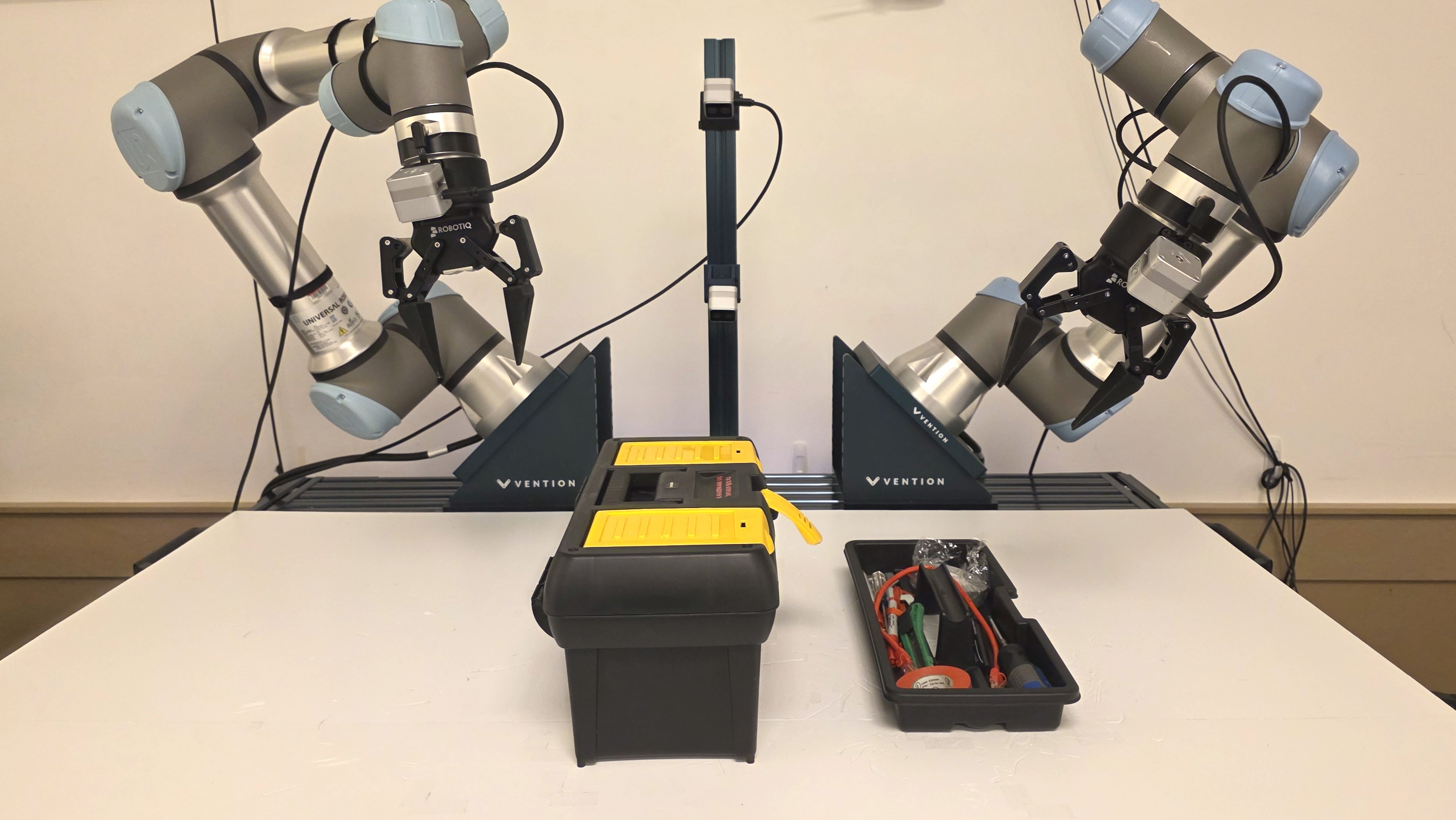
Microsoft’s Rho paper, submitted on September 29, 2026, introduced open-weight manipulation models adapted for YAM Box, UR AI Trainer, and FR3 Duo. The study separated learning a robot’s embodiment from learning a particular task. Its reported gains came from controlled experiments on those platforms, not from an assertion that one policy could operate any robot without adaptation. Rho research paper.
A robot trajectory records more than motion. It reflects a camera arrangement, a control interface, a task definition, and assumptions about what counts as success. Sharing trajectories across machines can accelerate learning, but only if those meanings remain legible. The challenge is to reuse experience without pretending that every robot experiences the world in the same way.
Open X-Embodiment, first submitted October 13, 2023, assembled robot datasets in standardized formats and explored policies trained across embodiments. The collaboration reported positive transfer in its experiments. That finding supports data sharing as a research direction while leaving specific deployment transfer to be tested. Open X-Embodiment paper.
Normalize without erasing
Our recommendation is to preserve metadata about the robot, sensors, action units, and task outcome. Standardization should make differences easier to interpret, not hide them. A command to move one unit is meaningless without knowing the coordinate frame and scale. Likewise, a successful trajectory is less useful if the final state was never independently checked.
Octo, submitted May 20, 2024, studied a generalist robot policy designed to adapt to different observations and action spaces. It used Open X-Embodiment data as a starting point. The relationship illustrates how shared data and adaptable model interfaces can support each other. Octo paper.
Validate the borrowed experience
We would compare a policy trained with shared data against a local baseline on the target robot. Include cases where the source experience may be misleading, such as different grippers or viewing angles. Shared data creates an opportunity for more capable autonomy. Demonstrating that the borrowed experience improves the actual task is what turns the opportunity into evidence.
The shared-data promise has a physical complication
A dataset can combine many demonstrations while hiding important differences in what the actions mean. A motion command may be expressed in joint coordinates on one robot and relative end-effector movement on another. Cameras can have different views, grippers can interact differently with objects, and control rates can change the relationship between successive observations.
The Open X-Embodiment work discussed below addressed the opportunity to learn across robots at scale. The practical challenge is to use the shared experience without pretending that the bodies are interchangeable. More data is useful when it adds relevant variation. It can also create ambiguity if the training system cannot identify which physical conventions produced an example.
Physical Intelligence explored another form of mixing
Physical Intelligence’s April 22, 2025 pi0.5 paper combined robot data with semantic prediction, web-derived information, and other tasks. It reported long-horizon manipulation in previously unseen homes. These were research demonstrations under the study’s conditions. The important comparison is the training strategy: broad knowledge and physical experience were combined rather than treating robot trajectories as the only useful source. Physical Intelligence pi0.5 paper.
Why embodiment adaptation matters
A model facing a new task on a known robot has a different problem from a model facing both a new task and an unfamiliar body. In the first case, it can focus on the desired interaction. In the second, it must also learn how observations and actions map onto the machine’s capabilities. Separating those problems can make the training process easier to interpret.
It also makes performance claims more precise. A result after robot-specific adaptation is not a zero-shot result on arbitrary hardware. That does not diminish its value. Industrial applications often have a fixed platform and changing work. A reusable model adapted to that platform could be useful even if substantial task-specific learning remains necessary.
Dataset scale is not the final outcome
The commercial question is how much additional work remains after downloading a checkpoint. A model trained on broad experience may reduce the demonstrations needed for a task, but the application still needs sensing, calibration, tooling, and a definition of success. Those requirements determine whether the research advantage survives contact with a production workflow.
There is also a reporting issue. Counting trajectories or robot types tells readers about the training corpus, not automatically about competence. A small number of difficult tasks can reveal a weakness that a large aggregate hides. Conversely, an adaptation method can be valuable without setting a universal benchmark record if it reliably reduces the cost of deploying a known family of tasks.
Rho’s staged approach and pi0.5’s heterogeneous training illustrate different ways of making shared data useful. The field is moving beyond the simple claim that more robot videos will solve manipulation. The stronger question is which experience transfers, what adaptation remains, and how clearly the resulting capability can be demonstrated on the physical machine.
The research context
Open X-Embodiment, introduced in October 2023, brought together data from 22 robot embodiments and investigated transfer through shared training. It established a concrete scale for cross-robot learning. The later Rho work asks how to specialize a shared starting point efficiently. Those are complementary questions: one concerns the benefit of pooling experience, the other the cost of turning pooled experience into a particular robot’s competence. The distinction matters when interpreting a dataset announcement. A broader collection can improve the foundation while still leaving substantial adaptation work. Progress is strongest when the research makes both gains visible, rather than treating the size of the corpus as a substitute for behavior on the final machine. Original research source.
Sources & evidence
This archive preserves its original editorial date. Sources describe the events and announcements discussed; they do not establish today’s status.