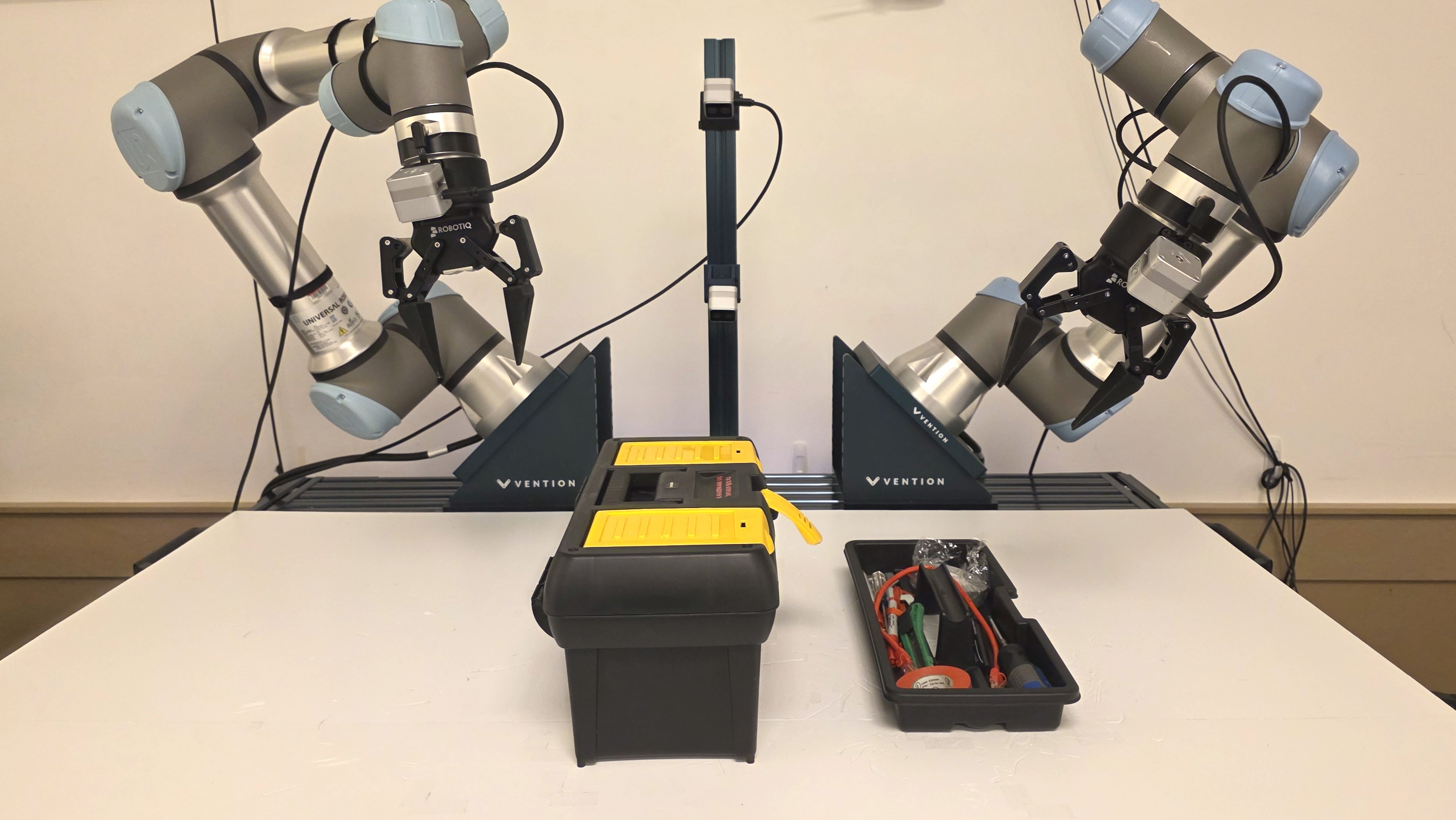
Rho’s September 2026 release included a base model and robot-specific checkpoints for three dual-arm platforms. The research team reported comparisons with other open-weight manipulation models on matched task demonstrations. That makes the release useful for reproduction and adaptation. It does not make the checkpoint a complete robot application, because the physical setup remains part of every result. Rho research paper.
A robot model that a team can run and adapt creates room for investigation. Engineers can compare versions, inspect interfaces, and test proposed fixes under controlled conditions. Yet access alone does not make the robot dependable. The autonomy benefit depends on whether the organization can turn that access into a disciplined account of behavior.
OpenVLA, first submitted June 13, 2024, presented an open vision-language-action model with released resources for adaptation. Its research addressed both generalist manipulation and efficient fine-tuning. These contributions support experimentation; they do not constitute a safety certification or a guarantee of performance on unseen equipment. OpenVLA paper.
Reproduce before modifying
Our recommendation is to establish a local baseline before changing the model. Record the sensor setup, action interface, weights, and evaluation cases. Otherwise, an apparent improvement may come from a changed camera or easier examples rather than the proposed method. A reproducible baseline makes the next engineering decision easier to defend.
Open X-Embodiment's October 13, 2023, paper addressed standardized robot data and cross-robot learning. Its emphasis on shared formats is relevant because model access is more useful when the data and interfaces around the model can also be understood and compared. Open X-Embodiment paper.
Make updates reversible
We would preserve the previous validated version and test a new one on the failures it is intended to fix as well as established capabilities. Document any regression before expanding authority. Open models can accelerate this cycle, especially for teams with the resources to investigate deeply. Their operational value comes from better evidence and control over change, not from openness being a substitute for validation.
The release changes who can experiment
Access to weights allows researchers and developers to adapt the model, examine its behavior, and compare alternatives without depending entirely on a remote provider. That can accelerate learning across the field. It also places more responsibility on the team assembling the application. The model may be available, while the exact sensors, control settings, or data conventions of a successful experiment still require careful reconstruction.
The OpenVLA and Open X-Embodiment research below illustrates why this matters. Reusable models and standardized data can lower barriers. They cannot erase the physical differences that make a command meaningful on one platform and wrong on another. Openness improves access to the starting point; it does not eliminate the need to understand the endpoint.
Generalization is a bounded empirical claim
The pi0.5 paper reported manipulation in homes absent from its training environments, using heterogeneous co-training to support transfer. That is evidence about the study’s tasks and evaluation settings. It should not be converted into a blanket statement that the model understands every new home, object, or industrial process. The boundary of the experiment is part of the result. Physical Intelligence pi0.5 paper.
The application around the weights
A deployed system needs to transform sensor readings into the format expected by the policy, transform its outputs into valid commands, and monitor what happens afterward. Calibration, timing, and action limits can all affect the outcome. If these differ from the reference setup, the same weights may produce different behavior.
This makes release documentation and reproducible examples important technical contributions. A checkpoint without enough context can be difficult to evaluate fairly. A documented pipeline lets another team identify whether a failure comes from the learned policy, the observation transform, or the control interface. That distinction is essential for improvement and for honest comparisons between models.
Open ecosystems need comparable evidence
The value of an open release grows when results can be reproduced and extended. It shrinks when every comparison changes the task distribution, demonstration budget, or success definition. A model can appear stronger because it received more adaptation, a better camera view, or a more forgiving test. These are legitimate design choices, but they should remain visible.
For industrial users, the most relevant evidence may be narrower than a broad leaderboard. A model that adapts predictably to a particular family of parts can be useful even if it is not strongest on every research task. The ability to inspect and modify it can help a team understand that fit. The remaining costs include data collection, validation, and maintaining the system as conditions change.
Rho’s open checkpoints and the earlier generalist releases are therefore meaningful progress in the infrastructure of physical autonomy. They allow more people to test what transfers and what does not. The strongest claims will come from that accumulated evidence, with the robot, task, training budget, and limitations stated clearly. Downloadability is a beginning; dependable behavior is the outcome that still has to be established.
The research context
OpenVLA’s June 2024 paper released a seven-billion-parameter vision-language-action model trained on 970,000 robot demonstrations. It also investigated efficient adaptation methods. This lineage explains why open release is significant: a team can begin from a learned representation rather than collect every capability from scratch. Yet the reference model’s training scale does not determine whether a particular installation is ready to operate. The local task may depend on a rare contact condition or an observation the model does not receive. Openness gives the team a way to investigate and adapt those gaps. It does not make the gaps disappear or remove the need to validate the complete system. Original research source.
Sources & evidence
This archive preserves its original editorial date. Sources describe the events and announcements discussed; they do not establish today’s status.