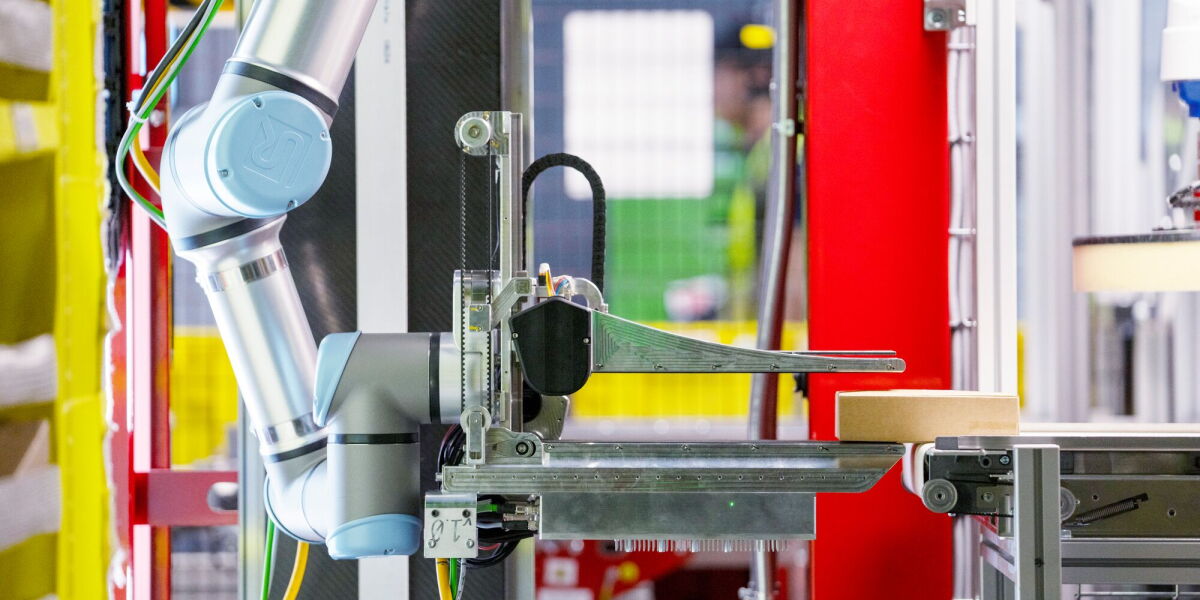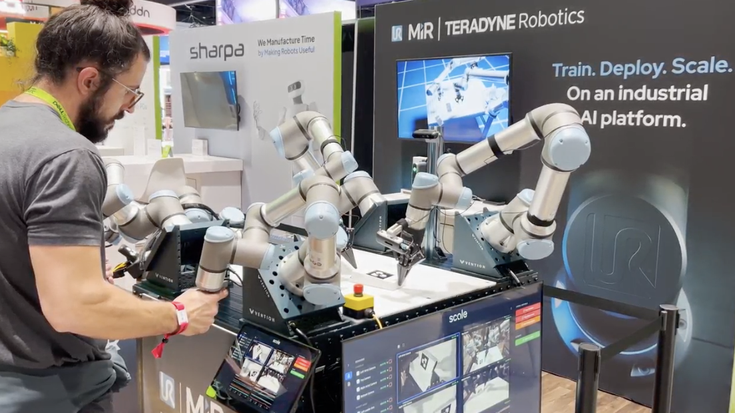
Universal Robots’ March 2026 AI Trainer demonstration paired two UR3e leader robots with two UR7e followers for smartphone packaging. Operators supplied haptic input while the system recorded the task. It is a concrete example of bimanual learning: the important behavior lies in how two manipulators coordinate around the same object, not just in either arm’s isolated accuracy. Universal Robots and Scale AI launch AI Trainer.
Two robot arms can hold and manipulate an object in ways one arm cannot. They also create more opportunities for poorly timed motion and conflicting contact. The autonomy challenge is to coordinate the task, not merely to coordinate movement. A system needs to understand which arm stabilizes, which changes the object, and when those roles should switch.
Learning Fine-Grained Bimanual Manipulation with Low-Cost Hardware, submitted April 23, 2023, introduced an imitation-learning setup and Action Chunking with Transformers. Its researchers evaluated precise tasks using demonstrations. The work is evidence for a method, not a blanket promise that inexpensive hardware can handle every delicate operation. Learning Fine-Grained Bimanual Manipulation.
Define the contact sequence
In our analysis, evaluation should focus on the transitions where coordination matters. For a hypothetical cable-insertion task, holding the connector steady and applying the right insertion motion are different requirements. The final electrical or mechanical connection should be checked independently of whether the arms followed a plausible trajectory. Smooth motion can still produce an incomplete assembly.
Transporter Networks, introduced October 27, 2020, approached manipulation through spatial rearrangement. It provides a complementary way to think about task structure: the desired relationship between objects matters, not just the exact path of the robot's joints. The technique was assessed in specified manipulation experiments. Transporter Networks paper.
Judge the finished object
We would record the final configuration, damage, and recovery burden alongside motion success. Training demonstrations should include the pauses and adjustments that make an operation dependable. Bimanual autonomy is compelling when it expands the range of accepted work the robot can produce. A complex-looking motion is less important than a correctly assembled, undamaged result.
Why two arms change the task
One arm can hold an object while the other manipulates it. That expands the range of possible work, but it also creates dependencies. If the holding arm moves unexpectedly, the working arm’s reference frame changes. If one gripper slips, the other may apply force in the wrong direction. A successful policy must preserve the relationship between both arms and the object throughout the action.
This makes synchronization more than a data-recording detail. A demonstration needs to show which observation preceded which motion and how contact changed the next step. Misaligned streams can teach a misleading relationship between cause and response. A clean final video may conceal those timing requirements, while the control system has to satisfy them on every attempt.
Vulcan shows another route to coordinated contact
Amazon’s Vulcan description distinguishes stowing tooling from a camera-and-suction picking arm. The system also watches for accidentally extracting a neighboring item. Its task-specific mechanics illustrate an alternative to treating every manipulation problem as a general two-handed skill: specialize the hardware around a clearly defined storage operation. Amazon Vulcan announcement.
Demonstrations organize the coordination problem
The ACT research cited below learned action chunks from demonstrations of bimanual tasks. Chunking can represent a short coordinated sequence rather than deciding each tiny movement independently. Transporter Networks explored spatial relationships for manipulation from another angle. Neither approach means that a recorded movement can simply be replayed whenever an object looks similar.
The object’s pose, friction, or compliance can change during execution. A learned sequence must remain connected to new observations. Otherwise an early alignment error can grow through the remainder of the action. The interesting question is how much coordination can be learned from demonstrations while preserving the ability to respond to contact that differs from the example.
Industrial usefulness is narrower than a spectacular demonstration
Smartphone packaging is a meaningful example because the task has a recognizable end state and several opportunities for misalignment. It is also one task. Success does not establish that the same system can handle unrelated assembly work without new data, tooling, or validation. The demonstration is evidence of a capability under its conditions, not a declaration of universal dexterity.
The commercial opportunity is to make such capabilities repeatable and adaptable. If demonstrations can reduce the time needed to introduce a new product variant, bimanual learning could expand the work available to industrial arms. If each variant requires a lengthy collection and debugging process, the economics will remain more limited.
The AI Trainer story is therefore about the infrastructure for learning coordinated contact. It gives developers a way to collect relevant interaction on industrial hardware. The outcome will depend on how efficiently that experience becomes a policy and how reliably the policy detects departures from the conditions it learned. Two arms provide more options, but useful autonomy comes from controlling their relationship.
The research context
The April 2023 ACT work used action chunking to learn bimanual manipulation from teleoperated demonstrations on a relatively low-cost system. Its importance to the industrial story is the representation of a coordinated sequence. A task can require one arm to hold a condition while the other performs a movement, and that relationship extends over time. Yet chunking also creates a question about responsiveness: how does the policy incorporate an unexpected change before the planned sequence is complete? A production application needs both coherent coordination and a way to react. Demonstration quality, observation timing, and the control interface jointly determine whether the learned sequence remains appropriate as contact develops. Original research source.
Sources & evidence
This archive preserves its original editorial date. Sources describe the events and announcements discussed; they do not establish today’s status.